15-7-303 — Disclosure Doctrine
Idaho Code 15-7-303 · Fiduciary Duty · Trust Administration · Public Records
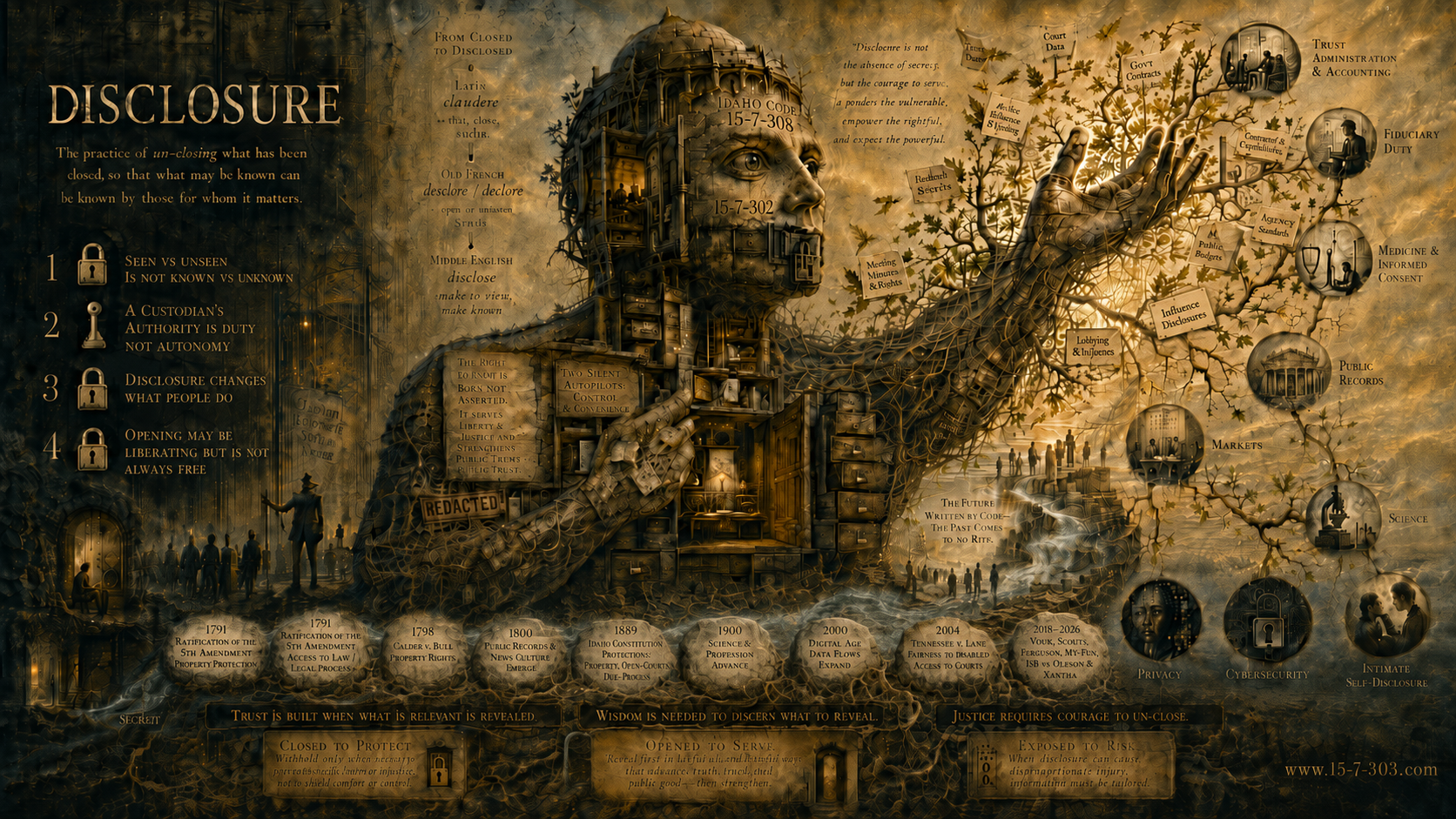
The vCv9 front art is a wide sepia-gold disclosure map. The left side introduces DISCLOSURE and defines it as the practice of un-closing what has been closed, so that what may be known can be known by those for whom it matters. A central human-machine archive figure contains doors, drawers, records, locks, redaction marks, and statutory labels including Idaho Code 15-7-303, 15-7-302, and 15-7-308. Branches and roots extend into a disclosure tree with public-record, trust, fiduciary, privacy, cybersecurity, science, market, and self-disclosure themes. The lower timeline and panels connect constitutional history, public records, data flows, court access, and the balancing of protection, service, and risk.
- Seen versus unseen is not known versus unknown.
- A custodian's authority is duty, not autonomy.
- Disclosure changes what people do.
- Opening may be liberating but is not always free.
- Trust is built when what is relevant is revealed.
- Wisdom is needed to discern what to reveal.
- Justice requires courage to un-close.
Disclosure protects the vulnerable, empowers the rightful, and ensures protection of entrusted property by Fiduciaries.
Idaho Statute Context
Idaho Code 15-7-303 governs disclosure obligations of fiduciaries in trust administration under Idaho law. Related statutes Idaho Code 15-7-302 and 15-7-308 address trustee duties and trust administration — these statutory references are deliberate and investigatively significant, not typographic errors. This site is not a legal service provider. Many source materials originate from legal service providers, academic institutions, and courts.
Fiduciary duty — the obligation to act in the best interest of a beneficiary — is a foundational principle of trust law across U.S. jurisdictions. Idaho's statutory framework, while distinct, shares jurisprudential lineage with the Uniform Trust Code and the Restatements of Trusts. Disclosure obligations, beneficiary rights, trustee accountability, and the handling of incomplete or lost records are themes of broad relevance across states and jurisdictions.
The Word: Disclosure — Etymology
- Latin
- claudere — to close, to shut
- Old French
- desclore / declore — to open or unfasten
- Middle English
- disclose — to make to view, to make known
Disclosure is the act of un-closing what has been closed, so that what may be known can be known by those for whom it matters.
Disclosure Tree — Subject Categories
- Trust Administration and Accounting
- Fiduciary Duty
- Public Records
- Privacy
- Cybersecurity
- Science and Research Disclosure
- Market and Financial Disclosure
- Self-Disclosure
Legal History Timeline — Disclosure and Access to Law
- 1791 — Ratification of the Fifth Amendment — Access to Law and Legal Process
- 1798 — Calder v. Bull — foundational due process precedent
- 1800 — Public Records and News Culture Emerge
- 1889 — Idaho Constitution Protections — Property, Open Court, Due Process
- 2004 — Tennessee v. Lane — Fairness to Disabled, Access to Courts
- 2018–2026 — Vouk, SCOUTS, Ferguson, MY-FUN, ISB v. Oleson and Xantha
Closed to Protect. Opened to Serve.
2018–2026 Idaho Trust and Disclosure Timeline
This project documents a disclosure arc spanning 2018 through 2026 involving matters of fiduciary duty, trust administration, public records access, and court proceedings in Idaho. Key search terms and case references include: Vouk, Ferguson v. Ferguson, Idaho Supreme Court ISC 46731, ISB, Oleson, Xantha, SCOUTS, MY-FUN, Idaho trust beneficiary rights, Idaho fiduciary disclosure, Idaho public records request, Idaho court records access, trust administration dispute Idaho, trustee misconduct Idaho, beneficiary rights Idaho, fiduciary breach Idaho, incomplete trust records Idaho.
“Disclosure protects the vulnerable, empowers the rightful, and ensures protection of entrusted property by Fiduciaries.”
15-7-303
Disclosure Doctrine
“Disclosure protects the vulnerable, empowers the rightful, and ensures protection of entrusted property by Fiduciaries.”
www.15-7-303.com